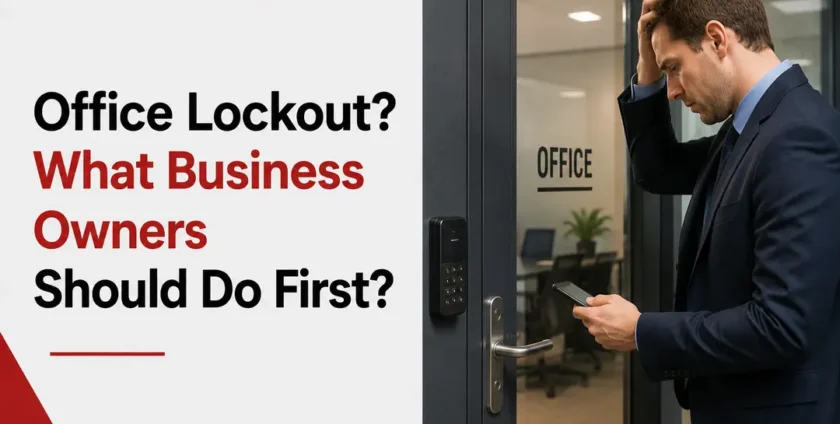
Getting locked out of your office or business can interrupt the entire day. Employees may be waiting outside, customers may be unable to enter, deliveries may be delayed, and operations may come to a stop.
Whether the key is lost, broken, locked inside, stolen, or no longer working, the most important thing is to handle the situation safely and professionally. Trying to force the door open can damage the lock, door frame, hardware, or access system, often creating a bigger problem than the original lockout.
Hughes Safe & Lock provides commercial locksmith and emergency locksmith services across South Louisiana, including Denham Springs, Baton Rouge, Covington, Mandeville, Madisonville, Slidell, New Orleans, and nearby communities.
Here is what business owners and managers should do first during an office lockout.
1. Stay Calm and Assess the Situation
An office lockout can feel urgent, especially if staff or customers are waiting. But before taking action, pause and review the situation.
Ask:
- Is anyone locked inside?
- Is anyone in danger?
- Are customers or employees waiting outside?
- Is the lock damaged?
- Is the key lost, stolen, broken, or locked inside?
- Is this a main entrance, back door, office suite, storage room, or restricted area?
- Is the lock mechanical, electronic, or part of an access control system?
- Is there another authorized way to enter?
If there is a safety emergency, call emergency services first. If the issue is access-related but not life-threatening, a commercial locksmith can help.
2. Check for Another Authorized Entry Point
Before calling for locksmith service, check whether another authorized entry point is available.
Depending on the property, there may be:
- A back entrance
- A side door
- A connected suite
- A landlord or property manager entrance
- A shared building entrance
- A maintenance access point
- A manager with another key
- A master key holder
- An access control administrator
Only use safe and authorized entry points. Do not try to climb through windows, force emergency exits, or enter through areas not meant for normal access.
3. Contact the Key Holder or Property Manager
If your office is in a leased commercial building, the property manager, landlord, or building maintenance team may have a spare key or master key.
For multi-tenant buildings, access may be controlled by:
- Property management
- Building security
- Facility management
- Office administrator
- Store manager
- Business owner
- Maintenance personnel
If a trusted person has the correct key, this may solve the problem quickly. If no one is available or the lock is not working, it is time to call a locksmith.
4. Do Not Force the Door Open
When a business is losing time, it can be tempting to force the door open. This is usually a bad idea.
Forcing a commercial door can damage:
- The lock cylinder
- Door frame
- Hinges
- Deadbolt
- Lever or handle
- Strike plate
- Exit hardware
- Door closer
- Glass door hardware
- Access control hardware
- Weather stripping
- Commercial door itself
Commercial doors and hardware can be more expensive to repair than standard residential hardware. A forced entry attempt can also leave the business less secure after the door is opened.
A professional commercial locksmith can help open the door with less risk of unnecessary damage.
5. Avoid DIY Lock Picking or Online Tricks
Online videos may make lock picking or bypassing a lock look simple, but attempting it yourself can damage the lock or make the locksmith’s job harder.
DIY methods can also create legal, safety, and insurance concerns, especially in a commercial property.
Avoid trying to:
- Pick the lock without training
- Pry the door
- Drill the lock
- Break glass
- Force the handle
- Remove commercial hardware
- Tamper with access control wiring
- Use improvised tools inside the lock
If this is a business property, it is better to call a professional locksmith.
6. Call a Commercial Locksmith
If you cannot access the office safely, call a commercial locksmith.
A commercial locksmith can help with office lockouts, broken keys, lock repairs, rekeying, commercial lock replacement, master key systems, access control, keyless entry systems, and emergency locksmith service.
When calling, provide:
- Business location
- Type of business property
- Which door is locked
- Whether the key is lost, stolen, broken, or inside
- Whether the lock is damaged
- Whether it is a standard lock, a high-security lock, a keypad, or an access control system
- Whether the issue is urgent
- Whether you need rekeying after access is restored
The more details you provide, the easier it is for the locksmith to understand the situation.
7. Ask Whether Rekeying Is Needed
An office lockout may be a simple access problem, but sometimes it points to a security issue. If the key is locked inside, you may only need help opening the door. But if the key is lost, stolen, or unaccounted for, rekeying may be recommended.
Knowing precisely when a business should rekey its locks helps maintain absolute control over physical building access.
Commercial rekeying changes the lock so old keys no longer work. This may be important if:
- A key was lost
- A key was stolen
- A former employee may have a key
- A vendor or contractor had access
- A tenant moved out
- Too many copies exist
- You are unsure who has access
- There was a security concern
After the lockout is resolved, ask the locksmith whether rekeying makes sense.
8. Check Whether the Lock Is Damaged
Sometimes an office lockout happens because the key is not the problem. The lock itself may be worn, damaged, jammed, or misaligned.
Signs of lock damage include:
- The key will not turn
- The key gets stuck
- The lock feels loose
- The handle does not engage
- The deadbolt does not line up
- The door does not close properly
- The lock sticks often
- The key broke inside the lock
- Employees have had trouble with the lock before
If the lock is damaged, opening the door may only solve the immediate problem. The lock may need repair or replacement to prevent future lockouts.
9. Review Employee Access After the Lockout
An office lockout is a good time to review who has access to your business. This is especially vital when looking at how to protect your business after an employee leaves, as out-of-circulation or unaccounted keys present significant liabilities.
Ask:
- Who currently has keys?
- Are any former employees still holding keys?
- Do vendors or cleaners have access?
- Are spare keys tracked?
- Are keys copied without approval?
- Does the business need a master key system?
- Would access control help?
- Should certain areas have restricted access?
- Are exterior doors secure enough?
Many businesses do not realize how many keys are in circulation until a lockout or security issue happens.
10. Consider a Master Key System
If your business has multiple doors, managers, employees, storage rooms, offices, or restricted areas, a master key system may help.
A master key system allows different keys to open different doors, while authorized people can use a master key to access multiple approved areas.
This can help with:
- Better key control
- Fewer keys to carry
- Employee access levels
- Manager access
- Tenant or suite access
- Restricted areas
- Property management
- Emergency access
If your office lockout happened because the right person did not have the right key, a master key system may be worth considering.
11. Consider Access Control for Your Business
Access control may also help prevent future office lockouts and improve security.
Instead of relying only on traditional keys, access control systems can use:
- Key cards
- Fobs
- Keypads
- Codes
- Electronic credentials
- Keyless entry systems
Access control may be useful if your business has:
- Employee turnover
- Multiple access levels
- Restricted rooms
- After-hours access needs
- Lost key concerns
- Vendor access
- Multiple doors
- Sensitive records or inventory
Depending on the system, access can be added, changed, or removed more easily than traditional keys.
12. Do You Need High-Security Locks?
If your office lockout revealed that your locks are old, easy to copy, or not secure enough, upgrading your door hardware is an excellent investment. When analyzing hardware, reviewing high-security locks vs standard locks shows how specialized keyways resist picking, drilling, and unauthorized duplication.
High-security locks can help with:
- Better key control
- Reduced unauthorized key duplication
- Stronger exterior door security
- Protection for restricted areas
- Commercial-grade lock security
- Sensitive office spaces
- Inventory or file rooms
Hughes Safe & Lock is a Medeco Security Center and can help commercial clients choose high-security lock options.
Common Causes of Office Lockouts
Office lockouts can happen for many reasons.
Common causes include:
- Lost office keys
- Keys locked inside
- Stolen keys
- Broken keys
- Key stuck in the lock
- Damaged locks
- Misaligned doors
- Employee turnover
- Wrong key
- Forgotten access code
- Keypad issues
- Access control problems
- Master key confusion
- Old hardware failure
Understanding the cause can help prevent the same issue from happening again.
How to Prevent Future Office Lockouts
After the lockout is fixed, take proactive steps to limit future operational disruptions. Researching how to improve security for a small business will offer a clear roadmap for combining lockout prevention with asset protection.
Helpful steps include:
- Keep a spare key with an authorized person
- Track who has business keys
- Rekey after employee turnover
- Replace worn locks before they fail
- Create a master key system
- Use access control where appropriate
- Limit who can duplicate keys
- Review vendor and contractor access
- Maintain door hardware
- Train managers on emergency access procedures
Establishing proper guidelines for key control for businesses is especially important for companies where a lockout completely halts daily operations.
Should You Keep a Spare Key Outside the Business?
Hiding a spare key outside the office is usually not a good security practice. Obvious hiding places can put the business at risk.
Instead, consider safer options such as:
- A trusted manager holding a spare
- Property manager access
- A controlled master key system
- Access control
- Secure key storage
- Clear emergency access procedures
A locksmith can help you decide what makes sense for your business.
Office Lockouts in Multi-Tenant Buildings
If your business is in a multi-tenant building, access may involve both your office door and shared building doors.
In that case, the lockout may involve:
- Your office suite key
- Building entry key
- Shared access card
- Landlord-controlled lock
- Property management master key
- Common area access
- After-hours building access
Before changing or rekeying locks, check whether your lease or property manager has rules about commercial door hardware and keys.
A commercial locksmith can work with the business owner or authorized property contact to resolve access issues properly.
Office Lockouts After Hours
After-hours office lockouts can be especially disruptive. You may need to access the building for closing, payroll, inventory, deliveries, client work, or emergency business needs.
If you are locked out after hours:
- Stay in a safe location
- Contact authorized key holders
- Check whether property management can help
- Do not force the door
- Call an emergency locksmith
- Ask whether rekeying is needed if keys are missing
Hughes Safe & Lock provides 24/7 emergency locksmith service across South Louisiana. If you are budgeting for scheduled or after-hours service calls, you can also read our summary of how much a locksmith costs in Louisiana to understand industry rates.
Call Hughes Safe & Lock for Office Lockout Service
If you are locked out of your office or business, Hughes Safe & Lock can help. We provide responsive commercial locksmith and emergency locksmith services across South Louisiana, including Denham Springs, Baton Rouge, Covington, Mandeville, Madisonville, Slidell, New Orleans, and nearby communities.
Our commercial locksmith services include office lockouts, commercial rekeying, lock replacement, master key systems, high-security locks, access control, keyless entry systems, and safes.
For professional commercial locksmith service, call Hughes Safe & Lock at 225-664-2815 or 985-809-5625, or submit an online request to contact us directly today.
FAQs About Office Lockouts
What should I do if I am locked out of my office?
First, check whether another authorized entry point or key holder is available. If you cannot enter safely, call a commercial locksmith.
Should I force the office door open?
No. Forcing a commercial door can damage the lock, frame, door hardware, glass, or access control system. It is usually better to call a locksmith.
Can a locksmith open a commercial office door?
Yes. A commercial locksmith can help with office lockouts, broken keys, damaged locks, rekeying, lock replacement, and emergency access issues.
Should I rekey the office after a lockout?
If the key was lost, stolen, or unaccounted for, rekeying may be recommended. If the key was simply locked inside, rekeying may not be necessary.
How can I prevent office lockouts?
Track business keys, keep authorized spare keys, rekey when needed, maintain locks, consider a master key system, and review whether access control would help.
Does Hughes Safe & Lock help with office lockouts?
Yes. Hughes Safe & Lock provides commercial and emergency locksmith services for office lockouts across South Louisiana.
- By: andrew
- Category: Commercial Locksmith
- 0 Comments
 Hughes Safe & Lock provides the finest quality work for residential and commercial clients.