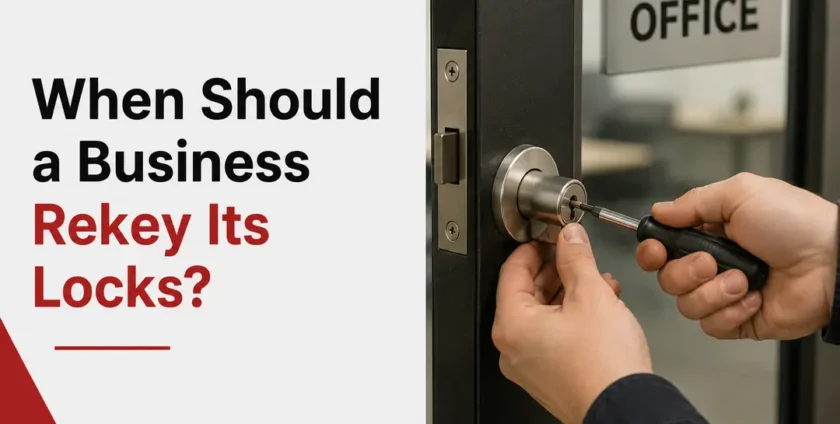
Business keys can change hands many times. Employees, managers, tenants, contractors, vendors, cleaning crews, maintenance workers, and previous occupants may all have had access to your building at some point.
Over time, it can become difficult to know exactly who has a key to your business.
That is where commercial rekeying can help.
Rekeying a business lock changes the internal parts of the lock so old keys no longer work. The lock hardware can often stay in place, but a new key is created for access. For many businesses, rekeying is a practical way to restore key control without replacing every lock.
Hughes Safe & Lock provides commercial locksmith services across South Louisiana, including Denham Springs, Baton Rouge, Covington, Mandeville, Madisonville, Slidell, New Orleans, and nearby communities.
Here are the most common times when a business should rekey its locks.
What Is Commercial Rekeying?
Commercial rekeying is the process of changing a lock so it works with a new key. The lock itself usually remains on the door, but the old key stops working.
This is different from lock replacement. When a lock is replaced, the old hardware is removed and new hardware is installed.
Rekeying is often a good option when the lock hardware is still in good condition, but the business needs better control over who has access.
Commercial rekeying may be used for:
- Office doors
- Retail entrances
- Warehouse doors
- Storage rooms
- File rooms
- Employee entrances
- Back doors
- Multi-tenant spaces
- Commercial suites
- Restricted areas
If your locks still work properly but your key control is uncertain, rekeying may be the right solution.
1. After an Employee Leaves
Employee turnover is one of the most common reasons businesses rekey their locks.
Even if a former employee returns their key, there is no guarantee that copies were not made. This does not always mean there is a serious threat, but it does create uncertainty. Learning how to protect your business after an employee leaves is an essential operational strategy for maintaining long-term commercial property protection.
Rekeying may be especially important if the employee had access to:
- Exterior doors
- Manager offices
- Cash rooms
- Inventory areas
- File rooms
- Storage rooms
- Equipment rooms
- Restricted areas
- Keys to other parts of the building
When an employee with important access leaves, it is smart to review your locks and decide whether rekeying is needed.
2. After Lost Business Keys
Lost business keys can create a major security concern.
If a key is lost, you may not know who has it, where it was found, or whether it can be connected to your business. If the key was lost with an ID badge, business card, bag, vehicle, or paperwork, the risk may be higher.
Rekeying can make the lost key useless.
Businesses should take lost keys seriously when they open:
- Exterior doors
- Office suites
- Back entrances
- Storage areas
- Cash rooms
- File rooms
- Warehouses
- Multi-tenant spaces
If a lost key could provide access to your building or sensitive areas, commercial rekeying should be considered.
3. After Stolen Keys
Stolen keys are more serious than misplaced keys.
If keys were stolen from an employee, vehicle, office, bag, or job site, the business should act quickly. A stolen key may be used intentionally, especially if the person who took it knows what it opens.
In this situation, rekeying can help protect the building, employees, inventory, records, and other assets.
Depending on the situation, you may need to rekey:
- Exterior locks
- Employee entrances
- Office doors
- Storage rooms
- Sensitive areas
- Master key systems
- Tenant spaces
- Commercial suites
If business keys were stolen, call a commercial locksmith as soon as possible.
4. After Moving Into a New Commercial Space
When a business moves into a new office, storefront, warehouse, or commercial suite, rekeying should be one of the first security steps.
Previous tenants, owners, contractors, cleaners, real estate agents, property managers, and maintenance workers may have had keys at some point.
Even if the space looks secure, you may not know how many old keys exist.
Rekeying after moving into a commercial space gives your business a clean start. It helps make sure that only authorized people have access going forward.
5. After Tenant Turnover
For landlords and property managers, tenant turnover is a major reason to rekey commercial locks.
When one tenant leaves and another moves in, rekeying helps protect the new tenant and limits access from old keys.
This is especially important for:
- Office suites
- Retail spaces
- Multi-tenant buildings
- Commercial rental units
- Warehouses
- Shared professional buildings
- Mixed-use properties
- Storage units
Even if the previous tenant returns all keys, copies may still exist. Rekeying creates a safer transition between occupants.
6. After Vendor or Contractor Access
Businesses often provide temporary access to vendors, contractors, maintenance teams, cleaners, delivery providers, or service technicians.
This may be necessary, but it can also create access concerns later.
You may want to rekey if:
- A contractor had a key for an extended period
- A cleaning crew changed
- Maintenance access was not tracked
- A vendor lost a key
- A temporary worker had access
- A project ended, and the keys were not returned
- You are unsure whether copies were made
Rekeying can help restore control after outside access is no longer needed.
7. After a Security Incident
If your business has experienced a break-in, attempted break-in, suspicious activity, employee conflict, theft, or unauthorized access concern, you should review your locks immediately.
Depending on what happened, you may need:
- Rekeying
- Lock replacement
- High-security lock upgrades
- Door hardware repair
- Master key system review
- Access control changes
- Safe service
- Emergency locksmith support
If the locks were not damaged but key access is uncertain, rekeying may be enough. If locks or doors were damaged, replacement or repair may be needed.
A commercial locksmith can inspect the situation and recommend the right next step.
8. When Too Many People Have Keys
Over time, businesses often hand out more keys than they realize.
Keys may go to:
- Employees
- Former employees
- Managers
- Cleaners
- Contractors
- Vendors
- Maintenance workers
- Property managers
- Tenants
- Family members
- Business partners
If you no longer have a clear list of who has keys, establishing rigid parameters around key control for businesses becomes vital. Every untracked key is a possible access risk, and rekeying gives you a chance to reset access configurations and build a better deployment structure going forward.
9. When You Want to Improve Key Control
Rekeying is not only for emergencies. It can also be part of a planned security improvement.
A business may rekey locks to:
- Reduce unnecessary access
- Organize key control
- Create new access levels
- Set up a master key system
- Limit employee access
- Update old keying
- Improve security after growth
- Simplify building access
If you are expanding a corporate space or updating your operational profile, incorporating a targeted infrastructure update is an excellent method when planning how to improve security for a small business.
10. When Setting Up a Master Key System
If your business has too many keys or too many access levels, a master key system may help.
A master key system allows different people to access different doors, while authorized managers or owners can access multiple approved areas with a master key.
Before setting up a master key system, rekeying may be needed to create a clean and organized structure.
This can be useful for:
- Offices
- Retail stores
- Warehouses
- Medical offices
- Schools
- Churches
- Apartment properties
- Multi-tenant buildings
- Property management companies
Hughes Safe & Lock can help businesses design master key systems that match their access needs.
11. When Locks Still Work, But Old Keys Are a Concern
Sometimes the lock hardware is perfectly fine, but key access is the issue.
In that case, replacing the entire lock may not be necessary. Rekeying may solve the problem by making old keys stop working.
This can be a practical option when:
- The locks are in good condition
- You want new keys
- You do not want to replace all hardware
- You need faster access control
- You want to reduce cost compared to full replacement
- You are not upgrading the hardware style or security level
A locksmith can tell you whether your existing commercial locks can be rekeyed.
Rekeying vs Replacing Commercial Locks
Rekeying and replacing locks are different services.
Rekeying changes the lock so it works with a new key while leaving the underlying mechanics intact. Replacing a lock means removing the old hardware entirely and installing fresh assemblies.
Reviewing the explicit mechanical differences of rekeying vs replacing locks can help you determine which option fits your immediate operational budget.
Rekeying may be best when:
- The lock works properly
- The hardware is in good condition
- The main concern is old keys
- You want to restore key control
- You need a practical security reset
Lock replacement may be better when:
- The lock is damaged
- The lock is worn out
- The hardware is outdated
- The lock is not secure enough
- The door hardware is failing
- You want higher-security locks
- You want new commercial-grade hardware
In some cases, your business may need both. Some locks can be rekeyed, while others should be replaced.
Should You Rekey or Use Access Control?
For some businesses, access control may be a better long-term solution than relying only on keys.
Access control systems use key cards, fobs, keypads, codes, or electronic credentials to manage entry. These systems can make it easier to add or remove access when employees change.
However, access control does not always replace every physical lock. Many businesses use a combination of:
- Rekeying
- Master key systems
- High-security locks
- Access control
- Keyless entry
- Commercial door hardware
If employee turnover, lost keys, or restricted access are ongoing issues, ask a commercial locksmith whether access control may make sense.
How Often Should a Business Rekey Its Locks?
There is no single schedule that works for every business.
A business should consider rekeying whenever key access becomes uncertain. That may happen after employee changes, lost keys, tenant turnover, stolen keys, vendor access, or moving into a new space.
Some businesses may need rekeying rarely. Others, especially rental properties, high-turnover workplaces, or multi-tenant buildings, may need it more often.
The best rule is simple: if you are not sure who has access, it is time to review your locks.
What Should You Do Before Rekeying?
Before rekeying your business locks, make a list of your access needs.
Consider:
- Which doors need to be rekeyed?
- Who should have keys?
- Who should no longer have access?
- Are there restricted areas?
- Are any locks damaged?
- Do you need a master key system?
- Do you need high-security locks?
- Are there exterior doors that need extra protection?
- Do vendors or contractors still need access?
- Are former employees or tenants a concern?
This helps the locksmith recommend the right solution.
How to Prevent Future Key Control Problems
After rekeying, your business should improve how keys are managed.
Good key control practices include:
- Track who receives each key
- Limit who can copy keys
- Avoid giving keys to unnecessary people
- Recover keys when employees leave
- Review access regularly
- Rekey after lost or stolen keys
- Use master key systems carefully
- Consider high-security locks where needed
- Consider access control for restricted areas
- Keep spare keys secure
Rekeying is helpful, but long-term security also depends on good access management. When factoring this into your commercial budget, checking out how much a locksmith costs in Louisiana will provide standard pricing benchmarks across our local industry.
Call Hughes Safe & Lock for Commercial Rekeying
If you are unsure who has keys to your business, Hughes Safe & Lock is ready to assist.
We provide premium commercial locksmith services across South Louisiana, including Denham Springs, Baton Rouge, Covington, Mandeville, Madisonville, Slidell, New Orleans, and nearby areas. Our professional services include business rekeying, master key systems, high-security locks, access control systems, keyless entry systems, lock replacement, commercial safes, and rapid emergency lock support.
For professional service or to discuss updating your facility’s master key architecture, click to contact us directly or call Hughes Safe & Lock at 225-664-2815 or 985-809-5625.
FAQs About Business Rekeying
When should a business rekey its locks?
A business should rekey its locks after employee turnover, lost keys, stolen keys, tenant changes, vendor access, moving into a new space, or any security concern involving old keys.
Is rekeying better than replacing commercial locks?
Rekeying is often a good option if the locks are still in good condition and the main concern is old keys. Replacing locks may be better if the hardware is damaged, outdated, or not secure enough.
Should I rekey after an employee leaves?
Yes, especially if the employee had access to exterior doors, restricted areas, offices, storage rooms, or sensitive business spaces.
Should commercial landlords rekey between tenants?
Yes. Rekeying between tenants helps protect the new tenant and prevents old keys from working.
Can rekeying be part of a master key system?
Yes. Rekeying is often part of creating or updating a master key system for a business.
Can Hughes Safe & Lock rekey business locks?
Yes. Hughes Safe & Lock provides commercial rekeying and locksmith services for businesses across South Louisiana.
- By: andrew
- Category: Commercial Locksmith
- 0 Comments
 Hughes Safe & Lock provides the finest quality work for residential and commercial clients.