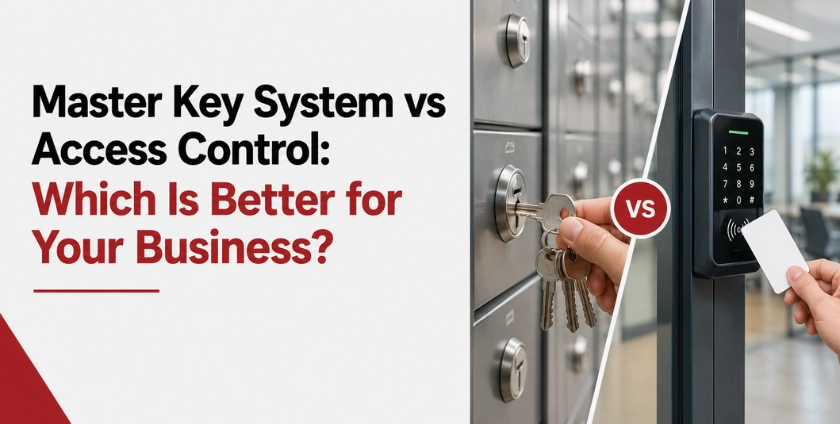
If your business has multiple doors, employees, offices or restricted areas, managing access to each space can get complicated.
You may be considering a master key system to organize physical keys, or an electronic access control system that lets employees enter using cards, codes or other electronic credentials.
Both solutions can help control access to your property, but they work differently, cost differently and require different levels of management.
A master key system is often a practical choice for businesses that want organized physical key access without installing electronic equipment. Access control may be better for businesses that frequently change employee permissions, need scheduled entry or want electronic activity records.
Some businesses benefit from combining both systems.
Here’s how to compare them before investing in a new security setup.
Master Key System vs Access Control: Quick Comparison
| Feature | Master Key System | Electronic Access Control |
| How doors are unlocked | Physical keys | Cards, fobs, PINs, or other electronic credentials |
| Employee access levels | Determined by key and lock configuration | Managed through system permissions |
| Upfront cost | Often lower when compatible locks already exist | Usually higher for a complete electronic installation |
| Adding an employee | Issue an appropriate key | Assign a new credential or PIN |
| Removing employee access | Recover keys or rekey affected locks if access is compromised | Revoke individual credentials, where supported |
| Entry activity records | Not inherently available | Available on systems with logging features |
| Scheduled access | Requires administrative procedures | Available on supported systems |
| Electricity or network | Generally not required for mechanical locks | Requirements vary by hardware and system |
| Maintenance | Keys, cylinders, and lock hardware | Electronic components, credentials, software, and locks |
| Best suited for | Straightforward, relatively stable access needs | Changing or more complex access requirements |
The better option depends on the number of doors, how often access changes, the sensitivity of restricted areas, and your budget.
What Is a Master Key System?
A master key system uses specially configured mechanical locks so that different keys provide different levels of access.
For example, consider a commercial office with ten rooms.
Employees may have keys that only open their assigned rooms. Department managers may have keys that open several rooms, while an authorized building manager has a master key that operates all designated locks within the system.
This allows a business to organize access without giving every employee a separate key for every door.
When does a master key system make sense?
A master key system may be appropriate when:
- Your business has several locked doors.
- Employees have relatively stable access requirements.
- Managers need access to multiple areas.
- You want to reduce the number of physical keys being carried.
- You prefer a mechanical system without electronic infrastructure.
- Your existing locks can support a properly designed master key arrangement.
Master key systems are commonly used in offices, retail businesses, apartment properties, warehouses and other buildings with different access levels.
However, a master key system does not automatically prevent key copying or provide a record of who entered a room. Key-control policies and appropriate hardware still matter.
For more on the benefits, read our guide on why businesses should use master key systems.
What Is Electronic Access Control?
Electronic access control uses electronic credentials and locking hardware to manage entry into a building or restricted area.
Depending on the system, employees may use a key card, keypad code, fob, or another approved credential to unlock a door.
Instead of changing mechanical keys whenever access requirements change, an authorized administrator can update permissions on many electronic systems.
For example, a business may allow all employees to enter the main office during working hours while restricting inventory rooms to supervisors.
A supported access control system can assign those permissions without requiring employees to carry separate physical keys.
When does access control make sense?
Electronic access control may be appropriate when:
- Employees frequently join or leave the business.
- Multiple people require different access permissions.
- Certain doors need restricted entry during specific hours.
- Management wants to disable lost credentials.
- The business needs entry activity records.
- Access requirements change frequently.
- The property has several sensitive or high-traffic entrances.
Not all electronic systems have the same features. Remote administration, audit logs, automatic schedules and integrations depend on the equipment and software you choose.
Which System Is More Affordable?
For many businesses, cost is one of the first considerations.
A master key system often has a lower initial cost, especially when existing locks are compatible and do not need complete replacement.
The project may involve rekeying cylinders, designing the key hierarchy, and issuing the necessary keys.
Electronic access control typically requires additional equipment and installation work.
Depending on the system, this may include electronic locks, readers, controllers, power supplies, wiring, software, and credential setup.
What about long-term costs?
The lowest upfront price does not always result in the lowest long-term cost.
A business using physical keys may have additional expenses when keys are lost, access needs change, or locks require rekeying.
Electronic access control can make certain permission changes easier, but it may involve ongoing software fees, credential replacement, equipment maintenance, or technical support.
Cost takeaway: If your business has a small number of doors and relatively stable staffing, a master key system may be more economical. If access changes frequently, electronic access control may provide operational benefits that justify the higher initial investment.
For additional pricing considerations, see how much does a commercial locksmith cost. You can also review general regional rates in our guide on how much does a locksmith cost in Louisiana.
Which Is Better for Employee Turnover?
Imagine an employee leaves your company but does not return their office key.
With a master key system, the business must determine which doors that key can open and decide when to rekey locks. If hardware needs updating rather than just key pinning, review our breakdown of rekeying vs. replacing locks.
The more access an employee has, the more complicated the situation can become.
With electronic access control, an administrator can typically deactivate an individually assigned credential without physically replacing the lock.
This is especially useful for businesses that regularly hire seasonal employees, contractors or temporary staff.
However, shared PINs and credentials can weaken that advantage. If several employees use the same entry code, the business may still need to change that code and distribute a replacement.
Best choice: Electronic access control often provides greater flexibility for frequent employee changes, provided credentials are managed individually and securely.
If staff departures are your immediate concern, read our guide on how to protect your business after an employee leaves.
Which Provides Better Security?
Neither system is automatically more secure in every situation.
A master key system’s security depends on lock quality, key-hierarchy design, who holds master keys, and how duplicate keys are controlled.
A poorly managed master key can create significant exposure because it may operate multiple doors.
Upgrading to restricted cylinders can significantly improve security for small business properties. To understand how these cylinders resist physical tampering and unauthorized key copies, explore our guide on high-security locks vs. standard locks.
Electronic access control offers different advantages. Supported systems can restrict permissions, disable credentials, create access schedules, and maintain entry records.
However, electronic systems also require proper configuration, maintenance, credential security and, in some cases, software or network protection.
An electronic reader doesn’t necessarily make a physical door more secure than a well-installed mechanical lock.
Security takeaway: Choose the system based on the risks you’re trying to address. Strong door hardware, sensible access permissions, and proper management are important with either option.
Which Is Easier to Manage Every Day?
The answer depends on how your business operates.
Master Key Systems: Once installed, a master key system can be straightforward to use.
Employees carry their assigned keys, and managers use appropriately authorized keys to access designated areas.
No electronic credentials to program or software dashboards to manage.
However, the business still needs a process for issuing keys, tracking duplicates, recovering keys and responding when keys go missing. If misplaced keys ever cause a disruption, knowing what to do during an office lockout will keep your staff prepared.
Electronic Access Control: Electronic access control can make access changes easier.
On supported systems, administrators can add credentials, revoke access, adjust schedules, or review entry records.
This can be valuable for larger teams or properties with multiple access levels.
However, someone must manage the system, keep its settings current, and arrange maintenance when equipment requires attention.
Best choice: Master key systems may be simpler for stable teams with straightforward access needs. Electronic access control can be more convenient for businesses with frequent permission changes.
What Happens During a Power Outage or System Failure?
This is an important consideration for businesses in Louisiana, where severe weather and power interruptions can affect building operations.
Mechanical master key systems generally do not require electricity to operate.
Electronic access control systems depend on their hardware design. Some systems include battery backup, mechanical key override, or other provisions for power or equipment failures.
Electronic locking hardware also behaves differently during a power loss. Some devices are designed to remain locked from the secured side, while others unlock under specified conditions.
Door operation must comply with applicable building, fire and life-safety requirements. Emergency egress must never depend on an improvised locking arrangement.
Before installing electronic access control, ask how the proposed system handles power outages, equipment failure, and emergency exit requirements.
Which System Is Better for Different Businesses?
The following examples can help you identify which solution may fit your property.
| Business type | Potentially suitable option | Why |
| Small professional office | Master key system | Few doors and stable employee access |
| Retail shop | Master key system or hybrid | Mechanical access for some doors, electronic access for selected entrances |
| Warehouse | Access control or hybrid | Different employee groups, restricted storage, changing schedules |
| Multi-tenant office building | Master key system or hybrid | Organized tenant and maintenance access |
| Medical office | Access control or hybrid | Sensitive areas, changing permissions, access-management requirements |
| School or institutional property | Site-specific assessment | More complex security and life-safety requirements |
| Growing business with frequent turnover | Access control | Faster credential changes and potential activity logging |
These are starting points, not universal recommendations. The final decision depends on each building’s layout, existing hardware, operating requirements, and applicable safety rules.
Can You Use Both a Master Key System and Access Control?
Yes. In fact, combining mechanical and electronic access can be practical for some commercial properties.
For example, a business might use electronic access control at its main employee entrance and mechanical master-keyed locks for selected offices, storage areas, or maintenance rooms.
This approach lets management use electronic credentials where permissions change frequently while keeping traditional keys for suitable low-traffic areas.
Example: A Small Commercial Office. Consider a two-story office building with:
- One main employee entrance
- Eight private offices
- Two storage rooms
- One equipment room
The business could evaluate electronic access for the main employee entrance and a mechanical master key system for certain interior doors.
Not every door necessarily needs electronic hardware.
However, plan the two systems together to avoid conflicting permissions, weak access points or problems with emergency egress.
A commercial locksmith can help evaluate the existing hardware and determine which combination is practical.
Five Questions to Ask Before Choosing
Before requesting a quote, consider these questions.
- How Many Doors Need Controlled Access? A three-door office may not need the same system as a commercial facility with several dozen entrances.
- How Often Do Employee Permissions Change? Frequent turnover, contractors, and temporary staff can make electronic credential management more attractive.
- Do You Need to Know Who Entered a Door? If the business needs records of entry activity, ask about electronic systems with audit logging capabilities. Traditional mechanical keys don’t inherently provide that information.
- What Is Your Budget? Consider installation, hardware replacement, credential management, rekeying, maintenance and possible software subscriptions.
- Can Your Existing Door Hardware Support the New System? Door type, lock compatibility, exit hardware, wiring access and applicable safety requirements may affect what you can install.
Answering these questions before getting quotes helps you compare suitable solutions instead of buying features you don’t need.
When Should You Call a Commercial Locksmith?
You don’t need to have the entire security system planned before contacting a locksmith. When selecting a contractor, make sure you know how to choose a licensed locksmith in Louisiana to ensure compliant installations.
Professional assistance may be useful when you’re opening a new business, taking over a commercial property, reorganizing employee access, upgrading old locks, or considering electronic entry systems.
A commercial locksmith can evaluate your existing locks, discuss your access requirements, and help identify practical hardware options.
This is particularly useful when multiple doors, restricted areas, master keys, or electronic locking systems need to work together.
Master Key Systems & Access Control in Southern Louisiana
Hughes Safe & Lock provides commercial locksmith services for businesses across Southern Louisiana, including master key systems, commercial rekeying, high-security locks, keyless entry, and access control.
Whether you’re looking for a more organized physical key system or considering electronic access for your property, our team can help you discuss the available options.
We serve commercial customers across our regional service locations, including our specialized commercial teams in Denham Springs and Covington, as well as Baton Rouge, Mandeville, Madisonville, Slidell, New Orleans, and surrounding communities. For urgent entry issues, our technicians also provide prompt emergency locksmith support.
- Denham Springs: (225) 664-2815
- Covington: (985) 809-5625
Need help choosing a commercial security solution?
Contact Hughes Safe & Lock to discuss your building, current locks, and access requirements.
Frequently Asked Questions
Is access control better than a master key system?
Not always. Access control benefits businesses that need frequent permission changes, electronic credentials or entry records. Master key systems may be more practical for businesses that prefer a simpler mechanical arrangement.
Is a master key system cheaper than electronic access control?
Master key systems often have lower initial costs when compatible mechanical hardware is already installed. Electronic access control generally requires additional equipment and setup, although long-term costs depend on how each system is managed.
Can a master key open every door in a building?
A properly configured master key can open the doors assigned to it within the system. It won’t automatically open every lock in a building, especially when separate systems or incompatible hardware are used.
Can access control work without the internet?
Some electronic access control systems can operate locally without continuous internet connectivity. Others depend on network or cloud features for certain functions. The exact capabilities vary by system.
Do businesses still need physical keys with access control?
Not necessarily for everyday entry, but some electronic systems retain mechanical overrides or other backup access arrangements. Requirements depend on the hardware, property, and applicable safety rules.
Can existing commercial locks be converted to a master key system?
Many compatible mechanical locks can be rekeyed into a master key arrangement. Other locks may need new cylinders or replacement hardware.
Is electronic access control suitable for small businesses?
Yes. A small business may benefit from electronic access if it frequently changes employee access or needs features such as scheduled entry. The added cost and maintenance should still be considered.
Can Hughes Safe & Lock help with both systems?
Hughes Safe & Lock offers master key systems and access control as part of its commercial locksmith services. Contact the team to discuss suitable options for your property.
- By: andrew
- Category: Business Security
- 0 Comments
 Hughes Safe & Lock provides the finest quality work for residential and commercial clients.
