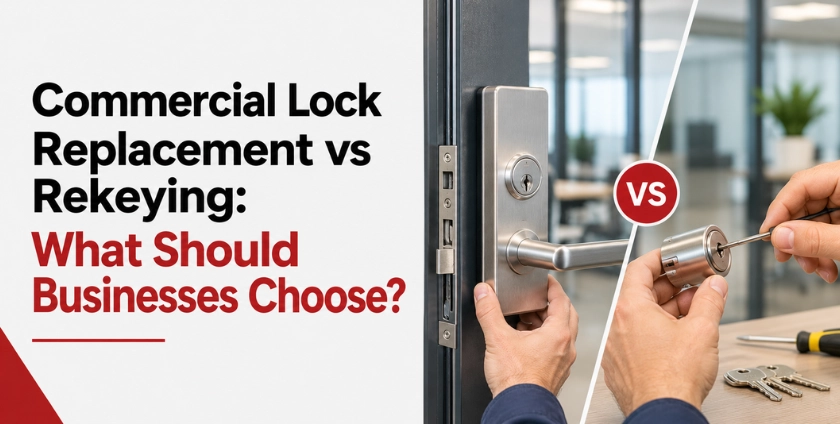
When an employee leaves, a tenant moves out, or a business loses track of who has access to its doors, one question often comes up: should you rekey the existing locks or replace them entirely?
Both options can help restore control over your property’s access, but they solve different problems.
Commercial rekeying is usually the better choice when your existing locks work properly and you simply need new keys. Commercial lock replacement makes more sense when the hardware is damaged, unreliable, outdated, or no longer meets your security requirements.
For businesses with multiple entrances, restricted areas, or master key systems, the decision can be more complicated. Replacing every lock may be unnecessary, but rekeying damaged or inadequate hardware won’t resolve the underlying problem.
Here’s how to decide which option makes sense for your business.
Commercial Lock Rekeying vs Replacement: Quick Comparison
| Factor | Commercial Rekeying | Commercial Lock Replacement |
| What changes? | Internal key configuration | Lock hardware or selected components |
| Existing hardware | Usually retained | Replaced or upgraded |
| Old keys | No longer operate properly rekeyed cylinders | Usually no longer work with new differently keyed hardware |
| Typical cost | Often lower | Usually higher due to hardware costs |
| Best for | Lost keys, employee turnover, tenant changes | Damaged locks, worn hardware, security upgrades |
| Improves lock strength? | Not by itself | Can, depending on replacement hardware |
| Master key compatibility | Can be incorporated into compatible systems | New hardware can be selected for master key compatibility |
| Electronic upgrade | Does not provide electronic access | May be part of an electronic access upgrade |
The right solution depends on whether you need to change who can enter or change the locking hardware itself. If you also need to compare residential or general lock principles, you can explore our basic comparison of rekeying vs. replacing locks.
What Is Commercial Lock Rekeying?
Commercial lock rekeying changes the internal configuration of a compatible lock cylinder so it operates with a different key.
The existing lock generally stays in place, but the previous key no longer operates the rekeyed cylinder.
For example, imagine a retail store with five entrance and storage-room locks. A former manager still has a key that opens several doors.
If the locks are working properly, a locksmith may be able to rekey the affected cylinders without replacing the entire lock assemblies.
This gives the business new keys and prevents the previous keys from working.
When is commercial rekeying appropriate?
Rekeying may make sense when:
- An employee leaves without returning keys.
- Business keys are lost or stolen.
- A new tenant moves into a commercial unit.
- A company purchases or leases a new building.
- Several employees have unauthorized key copies.
- A business wants to reorganize an existing master key system.
- The current lock hardware is still in good condition.
Rekeying helps restore key control for businesses, but it doesn’t automatically make a worn or low-security lock stronger.
For more information, see when should business rekey locks.
What Is Commercial Lock Replacement?
Commercial lock replacement involves removing an existing lock or relevant hardware components and installing new ones.
This may be necessary when the existing mechanism is damaged, worn out, incompatible with a required key system, or unsuitable for the security level your business needs.
For example, a storefront entrance with a damaged locking mechanism may not become reliable simply because its cylinder is rekeyed. If you are experiencing latch or hardware failure, see our troubleshooting guide for a commercial door lock not working.
Likewise, an office transitioning from conventional locks to restricted-key hardware may need new cylinders or other components.
When should a business replace its locks?
Replacement may be appropriate when:
- The lock repeatedly jams or fails.
- The locking mechanism has been damaged during a break-in.
- The hardware is heavily worn.
- The existing lock is unsuitable for the door or application.
- A business wants to upgrade to high-security locks.
- Replacement is needed to support a new access system.
- Existing cylinders cannot accommodate the desired key arrangement.
Complete lock replacement isn’t always necessary. In some cases, only the cylinder or another serviceable component needs changing.
A commercial locksmith can evaluate which parts require replacement before recommending an entire new assembly.
Which Costs Less: Commercial Rekeying or Lock Replacement?
For many businesses, rekeying is more affordable than replacing locks because it generally retains the existing hardware.
However, the final cost depends on the locks involved, the number of doors, and whether special cylinders or master key arrangements are required.
What affects rekeying costs?
The main considerations include the number of cylinders, lock type, key system complexity, labor, and number of new keys.
Standard commercial cylinders may be relatively straightforward to rekey, while restricted-key or master-keyed systems may require additional planning.
What affects replacement costs?
Commercial lock replacement includes the cost of new hardware, installation, and any modifications needed for compatibility.
High-security products, specialty commercial locks, and electronic locking components may increase the price.
Example: A Business With Eight Office Doors
Consider an office with eight functioning locks that need new keys after an employee departure.
- Option A: Rekeying
If the existing locks are compatible and in good condition, rekeying the affected cylinders may restore key control without replacing the complete assemblies. - Option B: Replacement
If several locks are damaged or the business wants higher-security hardware, replacing selected components may be the better investment.
A mixed approach may be most economical: rekey the usable locks and replace only those that need new hardware.
For a more detailed breakdown of budgeting considerations, read how much does a commercial locksmith cost. For broader statewide pricing benchmarks, see how much does a locksmith cost in Louisiana.
Should You Rekey or Replace Locks After an Employee Leaves?
When an employee leaves with a business key, the immediate concern is whether that key can still provide access to the property.
If the existing locks operate correctly, rekeying the affected cylinders is often a practical solution.
However, the decision should consider which doors the employee’s keys operate.
Questions to ask
- Did the employee have access to exterior entrances?
- Could their key open offices, cash rooms, or storage areas?
- Was the key part of a master key system?
- Are unauthorized duplicates possible?
- Did the employee have access to electronic entry credentials?
A compromised master key can affect several doors. Changing only one cylinder may not resolve the complete access concern.
Also, rekeying mechanical locks does not revoke electronic credentials. Those must be reviewed separately.
Recommendation: Evaluate the person’s full access permissions before deciding which locks or credentials need changing.
Read our practical guide on how to protect business after employee leaves for a broader departure checklist.
What Should Landlords Do Between Commercial Tenants?
Commercial property owners and managers regularly face key-control decisions when a tenant moves out.
Even when all issued keys have been returned, the landlord may not know whether additional copies exist.
Rekeying compatible locks can prevent the previous tenant’s keys from working without requiring new hardware throughout the property.
However, replacement may be necessary when locks are damaged, incompatible with the building’s key system, or do not meet the incoming tenant’s requirements.
For multi-tenant properties
Before changing locks, consider how the building’s existing master key system works.
Maintenance teams, authorized property managers, and other designated personnel may require access to specific doors.
An incorrectly planned lock change could disrupt these arrangements.
A commercial locksmith can help maintain or redesign an appropriate key hierarchy while securing the affected tenant spaces.
Should You Rekey or Replace Locks After a Break-In?
A break-in can create two separate concerns: physical damage and compromised access.
If someone has stolen keys but the locks remain undamaged, rekeying may be appropriate.
If the locking mechanism, door, or surrounding hardware has been forced or damaged, rekeying alone won’t address the physical security problem.
When replacement may be necessary
- The lock cylinder has been damaged.
- The lock body or latch no longer operates correctly.
- The locking hardware has been compromised.
- Existing security features are inadequate.
- The lock cannot reliably secure the entrance.
The door, frame, strike, and any required exit hardware may also need professional assessment. If an incident has disrupted staff access, follow proper procedures during an office lockout to secure entry safely.
For fire-rated or emergency exit doors, repairs and replacements must preserve applicable life-safety requirements.
Recommendation: Following a break-in, have the affected openings inspected before deciding whether to repair, rekey, or replace the hardware. When emergency entry or immediate board-up re-securing is required, contact an emergency locksmith.
Can You Rekey High-Security Commercial Locks?
Some high-security commercial locks can be rekeyed, but the process depends on the manufacturer’s system and the hardware involved.
Restricted-key systems may require authorized locksmiths, controlled key blanks, or specific procedures for changing the key configuration.
Businesses should not assume that all high-security cylinders can be serviced like ordinary locks.
Hughes Safe & Lock is a Medeco Security Center and offers high-security locking solutions for commercial customers.
If your current locks are outdated or your business needs better control over key duplication to improve security for small business premises, this may be an opportunity to evaluate an upgrade rather than simply issue another set of conventional keys.
Learn more about high-security locks vs. standard locks.
What If Your Business Uses a Master Key System?
Master key systems require additional planning when locks are rekeyed or replaced.
For example, a building may have individual office keys, department-level keys, and a master key used by authorized management.
Changing one cylinder without considering the rest of the system can disrupt these access arrangements.
Before making changes, a locksmith should understand:
- Which doors are part of the system
- Who needs access to each area
- Whether any keys have been lost or compromised
- Whether the existing cylinders are compatible
- Whether the business plans to expand or reorganize access
Is it better to rekey the system or replace it?
If compatible hardware is in good condition and the goal is to change key access, rekeying may be appropriate.
If the system has security limitations, incompatible hardware, or changing access requirements, selected cylinders or complete lock assemblies may need replacement.
In some situations, redesigning the key hierarchy is more useful than replacing every lock.
For more guidance, see why businesses should use master key systems.
When Is Upgrading to Access Control Better Than Either Option?
Rekeying and traditional lock replacement are not the only choices available to businesses.
If employee access changes frequently or the property has numerous restricted areas, electronic access control may be worth considering.
Depending on the system, electronic access control can allow authorized administrators to:
- Assign individual employee credentials
- Remove access permissions when employees leave
- Restrict access to selected doors
- Set access schedules
- Review supported entry activity records
Electronic access control generally requires a larger initial investment than straightforward rekeying.
It also introduces equipment, configuration, and maintenance requirements that mechanical keys don’t have.
However, businesses with frequent staffing changes may find electronic access easier to manage over time. Learn more in our overview of what is access control for business.
Compare the two approaches in our detailed guide: Master Key System vs Access Control: Which Is Better for Your Business?.
What Should Different Types of Businesses Choose?
The appropriate solution depends on the property, existing hardware, and reason for changing access.
| Business situation | Likely starting point | Why |
| Small office with functioning locks and lost keys | Rekey | Existing hardware may still be suitable |
| Retail store with a damaged entrance lock | Repair or replace | Mechanical damage requires assessment |
| Commercial landlord changing tenants | Rekey | Helps prevent previous keys from working |
| Warehouse with worn security hardware | Replace or upgrade | Existing hardware may be unreliable |
| Office expanding to additional rooms | Evaluate master key system | Access may need reorganizing |
| Business experiencing frequent employee turnover | Rekey or consider access control | Depends on the frequency and complexity of access changes |
| Property with compromised master keys | Review affected key system | Several doors may need changes |
| Business upgrading to restricted-key hardware | Replace compatible components | Existing locks may not support the new system |
These recommendations are starting points, not substitutes for an inspection.
A business may need a combination of rekeying, repairs, and selected hardware replacement.
9. How to Decide Which Option Your Business Needs
Before scheduling commercial locksmith work, use this checklist to clarify your requirements.
Step 1: Identify Why You Need the Change
Are you responding to lost keys, employee turnover, mechanical failure, or a planned security upgrade?
The reason determines whether changing the keys is sufficient.
Step 2: Check the Condition of Existing Locks
Pay attention to sticking keys, loose handles, inconsistent latching, or locks that no longer secure the door reliably.
These symptoms may indicate repair or replacement is necessary.
Step 3: Review Every Affected Entrance
Consider exterior doors, employee entrances, internal offices, inventory areas, storage rooms, and other restricted spaces.
Don’t assume one lock change will address access across the entire property.
Step 4: Consider Existing Key Systems
If your building uses master keys or restricted-key hardware, explain the existing arrangement before authorizing changes.
Step 5: Think About Future Access Requirements
If you’re planning renovations, staffing changes, or a new access control system, it may be more efficient to evaluate those requirements before purchasing new locks.
Step 6: Request a Commercial Locksmith Assessment
A licensed locksmith can help determine which cylinders can be rekeyed, which components need replacement, and whether higher-security hardware would be appropriate. Be sure to review how to choose a licensed locksmith in Louisiana before hiring.
How to Avoid Unnecessary Commercial Lock Replacement Costs
Replacing every lock in a commercial building can be expensive, particularly when multiple entrances or specialized hardware are involved.
However, keeping unsuitable or unreliable locks simply to reduce upfront costs may create larger problems later.
A practical approach is to evaluate the condition and function of each affected opening.
- Keep compatible, functioning hardware when possible. If the problem is limited to key control, rekeying may provide the needed change.
- Replace damaged or unsuitable components. Some doors may need only a cylinder replacement, while others require more extensive work.
- Review shared access requirements. Changes to master key arrangements should be planned together rather than handled as unrelated individual locks.
- Consider security improvements strategically. Higher-security locks may be appropriate at exterior entrances or restricted areas without necessarily replacing every interior office lock.
- Ask for an itemized quote. Request an explanation of which locks will be rekeyed, repaired, or replaced, along with the relevant hardware and labor.
This approach can help businesses invest in the right improvements rather than paying for unnecessary full replacements.
Commercial Lock Rekeying & Replacement in Southern Louisiana
Whether you’re opening a new business, preparing a property for a new tenant, dealing with lost keys, or replacing damaged commercial locks, Hughes Safe & Lock can help you evaluate your options.
Our commercial locksmith services include:
- Commercial lock rekeying
- Lock replacement
- Master key systems
- High-security locks
- Key replacement
- Keyless entry and access control
Hughes Safe & Lock serves commercial clients across Southern Louisiana through our regional service locations, including specialized teams in Denham Springs and Covington, as well as Baton Rouge, Mandeville, Madisonville, Slidell, and New Orleans. If you need residential services alongside commercial properties, our technicians also provide complete residential locksmith solutions.
- Denham Springs: (225) 664-2815
- Covington: (985) 809-5625
Not sure whether your business needs rekeying or new locks? Contact Hughes Safe & Lock with your property location, number of affected doors, and the reason you’re considering a change.
Frequently Asked Questions
Is it cheaper to rekey or replace commercial locks?
Rekeying is often less expensive because compatible existing hardware can remain in place. Replacement generally involves additional materials and installation labor. The exact cost depends on the locks and work required.
Should a business rekey its locks after an employee leaves?
Rekeying may be appropriate if the former employee had access to physical keys that could still operate the property. Review all affected doors and any master key arrangements before making changes.
Can all commercial locks be rekeyed?
No. Rekeying depends on the lock type, cylinder design, compatibility, and condition. Some locks require replacement cylinders or new hardware.
Does rekeying make a commercial lock more secure?
Rekeying prevents previous keys from operating the rekeyed cylinder, but it doesn’t automatically improve the lock’s physical strength or resistance to forced entry.
Should landlords change commercial locks between tenants?
Landlords should evaluate key control between occupancies. Rekeying compatible locks is often a practical option, while replacement may be necessary if the hardware is damaged or unsuitable.
Can commercial locks be rekeyed to use the same key?
Some compatible locks can be configured to operate with the same key. The feasibility depends on their cylinder types, keyways, and any existing master key system.
Should damaged commercial locks be rekeyed or replaced?
Mechanical damage generally requires repair or replacement rather than rekeying alone. A professional assessment can determine which components need attention.
Can you replace only one lock in a master key system?
Sometimes, provided the replacement hardware is compatible and can be configured within the existing key hierarchy. Otherwise, changes to the broader system may be required.
Does Hughes Safe & Lock offer commercial rekeying and lock replacement?
Yes. Hughes Safe & Lock offers both services for commercial customers across Southern Louisiana. Contact the Denham Springs or Covington team to discuss your property and request a quote.
- By: andrew
- Category: Commercial Locksmith
- 0 Comments
 Hughes Safe & Lock provides the finest quality work for residential and commercial clients.
