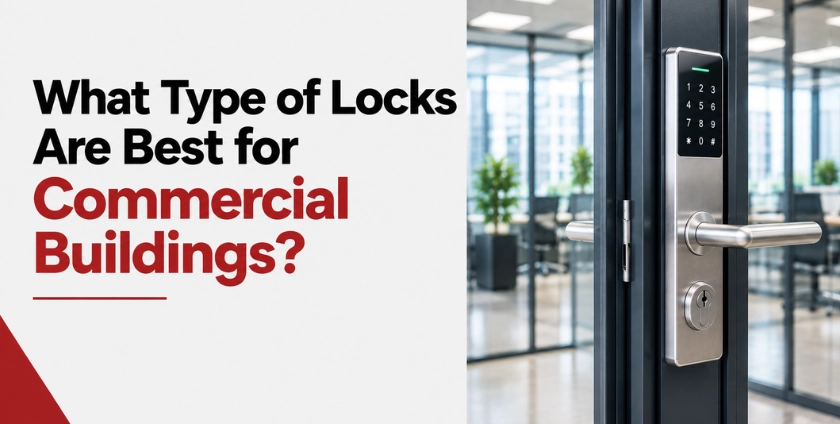
The best lock for a commercial building depends on the door type, how often it’s used, who needs access and what you’re trying to protect.
A small office may need durable cylindrical lever locks and a master key system. A retail storefront may use a mortise lock designed for its aluminum-and-glass entrance. A warehouse may require heavy-duty hardware, high-security cylinders, or electronic access control for employee entrances.
For many businesses, commercial-grade mortise and cylindrical locks are practical mechanical options. Consider high-security locks when key control and physical security are priorities, and electronic access control when employee permissions change frequently.
However, no single lock type is best for every commercial entrance. The right choice must also work with the door, frame, existing hardware, and applicable fire and life-safety requirements.
This guide compares common commercial door locks, where they’re used, and how to choose the right option for your building.
What Are the Best Types of Commercial Door Locks?
Here’s a quick comparison of the most common options.
| Lock type | Common commercial application | Main advantage |
| Cylindrical lever locks | Offices, interior doors, employee areas | Durable, familiar operation |
| Mortise locks | Storefronts, offices, heavy-use entrances | Robust integrated locking hardware |
| Commercial deadbolts | Suitable for doors needing additional mechanical security | Stronger resistance to certain forced-entry methods |
| High-security lock cylinders | Restricted rooms, exterior doors, sensitive areas | Improved key control and security features |
| Keypad and keyless locks | Staff entrances, smaller offices, selected restricted areas | Access without distributing traditional keys |
| Electronic access control | Multi-user offices, warehouses, larger facilities | Flexible permissions and credential management |
| Exit devices or panic hardware | Designated exits and applicable assembly or occupancy doors | Supports safe, code-compliant emergency exit |
Some are complete locksets, while others are cylinders, electronic systems or exit hardware. They can be combined into a complete commercial door solution.
Cylindrical Lever Locks: A Practical Choice for Office Doors
Cylindrical lever locks are widely used in commercial buildings, particularly on interior office doors and employee areas.
The lock mechanism fits into a bored opening in the door and typically operates through a lever handle.
These locks are available in different functions, including passage, privacy, storeroom and classroom-style configurations.
Where are cylindrical locks commonly used?
- Individual offices
- Administrative rooms
- Interior business entrances
- Employee-only areas
- Storage rooms
- Meeting rooms
Why choose them?
Commercial-grade cylindrical locks provide reliable operation for doors with regular use.
They come in various functions and can often integrate with compatible master key systems. To understand how key hierarchies streamline employee management, explore why businesses should use master key systems.
Lever handles are also commonly selected to meet accessibility requirements, but you must evaluate the entire opening for compliance.
What should businesses consider?
Not every cylindrical lock is designed for the same frequency of use.
A lock suitable for a lightly used private office may not suit a busy employee entrance.
Before purchasing, check the hardware grade, door compatibility, durability and intended application.
Best suited for: Offices and other commercial spaces needing practical mechanical access control.
Mortise Locks: Heavy-Duty Hardware for Commercial Entrances
Mortise locks use a lock body fitted into a specially prepared pocket within the door.
They are common in commercial and institutional properties that require durable locking hardware.
Depending on the model, a mortise lock may integrate a latch, deadbolt, and other functions within the lock body.
Where are mortise locks used?
- Office building entrances
- Commercial storefronts
- Hotels and hospitality properties
- Institutional buildings
- Heavy-use interior and exterior doors
Certain narrow-stile mortise lock designs are also used with aluminum storefront doors. If your current entrance hardware is sticking or failing to latch, review our diagnostic guide on a commercial door lock not working.
Why choose a mortise lock?
A suitable commercial mortise lock offers robust construction, multiple functions and compatibility with selected high-security cylinders or master key systems.
Its design makes it useful for frequently used entrances.
Are mortise locks always better than cylindrical locks?
Not necessarily.
Mortise locks can be more complex to install and may require specific door preparation. Replacing an existing mortise lock also involves matching the new hardware to the door’s current cutouts and dimensions.
A high-quality cylindrical lock may be perfectly appropriate for many commercial applications.
Best suited for: Compatible commercial entrances and heavy-use doors where mortise hardware is appropriate.
Commercial Deadbolts: Added Mechanical Security
Deadbolts use a solid locking bolt that extends into the door frame.
Unlike a spring latch, a deadbolt generally requires deliberate key or thumb-turn operation, depending on its design.
They can be useful for certain commercial exterior doors, storage areas, and restricted spaces.
What are the advantages?
A properly selected and installed deadbolt can provide additional resistance to some forced-entry methods.
Deadbolts may also be available with compatible high-security cylinders.
What are the limitations?
Deadbolts are not appropriate for every commercial entrance.
A door that must allow immediate emergency exit cannot be fitted with hardware that unlawfully restricts egress.
For this reason, businesses should never assume they can add a residential-style deadbolt to a commercial exit door.
The lock must meet the door’s required function, occupancy, accessibility requirements and applicable building codes.
Best suited for: Appropriate commercial doors where additional mechanical security is permitted and properly specified.
High-Security Locks: Better Protection and Key Control
High-security commercial locks are designed for businesses that need stronger physical security, improved key management, or both.
Depending on the product, features may include enhanced resistance to certain lock attacks and restricted-key systems designed to control unauthorized duplication.
Hughes Safe & Lock is a Medeco Security Center and offers high-security locking solutions for commercial customers.
When should a business consider high-security locks?
They may be appropriate for:
- Exterior commercial entrances
- Sensitive storage rooms
- Inventory areas
- Management offices
- Commercial properties with multiple keyholders
- Businesses concerned about uncontrolled key duplication
Why does key control matter?
A business may have durable locks but still struggle with security if employees or contractors can freely duplicate keys.
Some restricted-key systems provide additional control over how replacement keys are issued. Strict key control helps prevent unauthorized copies and protects sensitive company inventory.
However, restricted key duplication and physical attack resistance are different features. A business should review the proposed hardware’s exact specifications.
Do you need high-security locks on every door?
Not always.
For example, a company might prioritize high-security cylinders at exterior entrances and sensitive storage areas while using standard commercial-grade hardware on lower-risk interior rooms.
This helps allocate the security budget based on actual risks and learn practical ways to improve security for small business premises.
Read our existing guide on high-security locks vs. standard locks for a detailed comparison.
Best suited for: Businesses that need controlled-key solutions or stronger physical lock security.
Keypad and Keyless Commercial Locks: Convenient Employee Access
Keypad and electronic keyless locks allow authorized users to enter without relying entirely on traditional mechanical keys.
Depending on the model, access may be provided through a PIN code, card, fob, or another credential.
Some products operate as standalone devices, while others connect to a broader access control system.
When are keyless locks useful?
They may be practical for businesses with:
- Employee-only entrances
- Shared office spaces
- Frequently used restricted rooms
- Multiple authorized users
- A desire to reduce traditional key distribution
What should businesses compare?
Before purchasing, consider how you create, change and remove access credentials.
For example, a keypad shared by ten employees may require changing the code whenever an employee who knows it leaves. If unreturned physical keys or shared codes become an issue during staff departures, read our checklist on how to protect business after an employee leaves.
Individually assigned credentials can simplify access management.
Also consider battery requirements, backup access, door compatibility, and maintenance.
Best suited for: Businesses seeking convenient employee entry and manageable access credentials.
Electronic Access Control: For Businesses With Multiple Users or Doors
Electronic access control goes beyond a simple keypad lock.
Depending on the system, businesses can assign credentials, manage permissions, restrict entry by schedule, and maintain access activity records.
This is especially useful for properties with multiple entrances, changing staff or sensitive rooms.
Where is access control commonly considered?
- Multi-tenant office buildings
- Warehouses
- Medical offices
- Larger retail properties
- Employee entrances
- Buildings with restricted access areas
Why choose electronic access control?
Consider an office with 30 employees.
With physical keys, employee departures or lost keys may require retrieving keys, changing cylinders, or reviewing access across multiple doors.
With a properly configured electronic system using individual credentials, an administrator can often disable a departing employee’s access without changing the mechanical locks.
What are the disadvantages?
Access control generally requires more installation and maintenance than straightforward mechanical locks.
Depending on the system, costs may include readers, electronic locking hardware, controllers, wiring, credentials, software and ongoing support.
The electronic locking configuration must also meet relevant emergency egress and life-safety requirements.
For a more detailed decision guide, read Master Key System vs Access Control: Which Is Better for Your Business?.
Best suited for: Businesses that need frequent access changes, multiple permission levels, or electronic entry management.
Panic Bars and Exit Devices: Essential for Certain Commercial Doors
Panic bars, also called panic hardware, let occupants exit through applicable doors using a release mechanism.
They are especially relevant to designated exits and buildings where specific occupancy or life-safety rules require them.
Where might exit devices be needed?
Depending on the building classification, occupant load, door function, and applicable code, exit hardware may be required in certain:
- Schools
- Restaurants
- Retail buildings
- Public assembly spaces
- Commercial facilities
- Institutional buildings
However, not every commercial building requires panic hardware on every exit.
What should businesses know?
Exit hardware serves a different purpose from an ordinary entry lock.
Its primary function is to allow required egress while supporting the door’s security and operational needs.
Some exit devices can integrate with access control or electric hardware, provided the complete assembly suits the application and complies with applicable requirements. If malfunctioning exit doors ever leave your staff locked out, follow the steps in office lockout: what to do for quick assistance.
Important: Never install or modify a commercial door lock in a way that prevents required emergency exit.
Best suited for: Doors that require exit-device hardware or where it is otherwise appropriate under applicable building and life-safety rules.
Which Locks Are Best for Different Commercial Buildings?
Choosing the right hardware depends on the building, not just the lock’s advertised security level.
| Property type | Locks or systems worth considering | Main consideration |
| Small office | Commercial cylindrical locks, master key systems | Managing employee and manager access |
| Retail storefront | Compatible mortise locks, high-security cylinders | Door design and exterior security |
| Restaurant | Commercial lever locks, appropriate exit hardware | High traffic and safe egress |
| Warehouse | Heavy-duty locks, high-security systems, access control | Employee access and restricted areas |
| Medical office | Master key systems, high-security locks, access control | Different access levels and sensitive spaces |
| Multi-tenant building | Master key systems and access control | Tenant turnover and shared areas |
| Professional services office | Cylindrical or mortise locks, controlled-key systems | Secure offices and restricted rooms |
| Industrial facility | Application-specific heavy-duty hardware and access control | Multiple entrances, operations, and safety requirements |
These examples provide general starting points. Review the existing door construction, applicable codes and specific access requirements before selecting hardware.
What Do ANSI/BHMA Lock Grades Mean?
When comparing commercial locking hardware, you may come across ANSI/BHMA Grade 1, Grade 2, and Grade 3 ratings.
These grades reflect performance testing for applicable lock and hardware categories. The precise testing requirements depend on the specific standard.
- Grade 1: Generally represents the highest performance grade within the applicable three-grade hardware standard. Grade 1 products are often considered for demanding commercial applications and frequently used entrances.
- Grade 2: Represents an intermediate performance grade under applicable standards. Grade 2 hardware may be appropriate for certain commercial applications depending on the door’s usage and requirements.
- Grade 3: Generally represents a lower performance level than Grades 1 and 2 under the relevant grading system. Grade 3 products are typically less suitable for demanding, high-traffic commercial applications.
Does every commercial lock need to be Grade 1?
No.
The right specification depends on the hardware type, door function, traffic, security needs, and applicable project requirements.
Not all commercial hardware uses the same grading standard, so don’t compare grade numbers across unrelated product categories without checking the relevant specifications.
For frequently used business entrances, ask whether the hardware is tested for demanding commercial operation.
What Should You Consider Before Buying Commercial Door Locks?
Before selecting hardware for a new building or replacing existing locks, review these factors.
- Door Type and Compatibility: A hollow metal office door, aluminum storefront door, wood door, and fire-rated entrance may require different hardware. The replacement lock must match the door’s construction, preparation and function.
- Frequency of Use: A rarely accessed storage room and a main employee entrance may experience very different wear. Choose hardware designed for the expected traffic level.
- Number of Employees and Keyholders: If only a few people need access, traditional mechanical locks may be sufficient. Properties with changing staff or multiple permission levels may benefit from a master key system or electronic access control.
- Security and Key Control: Consider whether the primary concern is unauthorized key duplication, physical forced entry, managing employee permissions, or securing specific rooms. Different locks address different risks.
- Fire, Accessibility, and Emergency Exit Requirements: Select commercial locking hardware with the full door assembly and applicable codes in mind. Fire-rated doors, accessible entrances, and required exit routes may need specific hardware or operating functions.
- Long-Term Maintenance: Compare not only the purchase price but also servicing, replacement keys, credentials, maintenance, and future expansion. The cheapest hardware isn’t always the most economical option for a frequently used commercial entrance.
Should You Replace All Your Commercial Locks?
If your business already has functional, appropriate hardware, you may not need to replace every lock.
For example, a property owner who has lost control of several physical keys may be able to rekey compatible locks rather than replace the complete assemblies. Review when to rekey locks to decide what’s right for your situation.
However, replacement may make sense when locks are damaged, unreliable, unsuitable for the door or incompatible with a planned security upgrade. If you manage residential or mixed-use properties, you can also review general principles in our breakdown of rekeying vs. replacing locks.
A commercial locksmith can help determine which locks should remain, which can be rekeyed, and which need replacement.
Read Commercial Lock Replacement vs Rekeying: What Should Businesses Choose? for a more detailed comparison.
How Much Do Commercial Door Locks Cost?
Commercial door lock prices vary considerably depending on the hardware category, grade, brand, locking function, and installation requirements.
A straightforward mechanical lock replacement may involve substantially less equipment than a multi-door electronic access control project.
Factors influencing total cost include:
- Hardware type and grade
- Door preparation and compatibility
- High-security cylinders
- Master key arrangements
- Electronic readers and controllers
- Installation labor
- Number of doors
- Required fire-rated or exit hardware
- Maintenance and software requirements
For existing buildings, the condition of the doors and surrounding hardware can also affect installation costs.
Instead of selecting locks based only on the price of individual products, request an estimate for the complete door solution.
See how much a commercial locksmith costs for budgeting guidance, or review broader regional rates in how much does a locksmith cost in Louisiana.
How to Choose a Commercial Locksmith for Your Building
Selecting commercial locks involves more than purchasing hardware that fits the door. Always work with a properly vetted professional by following guidance on how to choose a licensed locksmith in Louisiana.
A qualified commercial locksmith can evaluate existing locks, confirm compatibility, understand employee access needs, and recommend the right locking setup.
Before requesting a quote, prepare the following information:
- Type of commercial property
- Number of doors requiring service
- Interior or exterior door locations
- Existing lock brands or photographs
- Problems with current hardware
- Number of employees or authorized users
- Interest in master keys, restricted keys, or access control
- Any fire-rated or designated exit doors
This information helps the locksmith understand your property and identify which solutions may be appropriate.
Commercial Door Locks and Locksmith Services in Southern Louisiana
The best commercial door lock fits your building, supports daily operations, and provides appropriate security without creating unnecessary access problems.
Hughes Safe & Lock provides complete commercial locksmith services across Southern Louisiana, including:
- Commercial lock installation and replacement
- Business rekeying
- Master key systems
- Medeco high-security locks
- Keyless entry systems
- Electronic access control
- Commercial door hardware
- Emergency locksmith assistance
Whether you’re securing a retail storefront, office building, warehouse, or multi-tenant property, our team can help you discuss the available options.
We serve businesses across our regional service locations, including our specialized commercial teams in Denham Springs and Covington, as well as Baton Rouge, Mandeville, Madisonville, Slidell, New Orleans, and surrounding areas. For residential property owners, we also offer comprehensive residential locksmith services and 24/7 emergency locksmith response.
- Denham Springs: (225) 664-2815
- Covington: (985) 809-5625
Need help choosing commercial door locks?
Contact Hughes Safe & Lock with your building location, door types, and security requirements.
Frequently Asked Questions About Commercial Door Locks
What is the most secure type of commercial door lock?
No single lock is best for every commercial door. Security depends on the lock’s construction, key-control features, installation, door strength, and intended application. High-security locks can add useful features for sensitive entrances, but the entire door assembly matters.
Are mortise locks better than cylindrical locks for businesses?
Mortise locks can suit heavy-use commercial entrances, while quality cylindrical locks work well for many offices and interior doors. The best option depends on the door’s existing preparation, hardware quality and required function.
What locks are best for office doors?
Commercial-grade cylindrical lever locks and mortise locks are common options. Businesses with multiple offices may also benefit from master key systems or electronic access control.
What type of lock is best for a storefront door?
The correct hardware depends on whether the storefront has an aluminum, glass, steel, or other door assembly. Common considerations include compatible mortise locks, high-security cylinders and appropriate commercial locking hardware.
Should businesses use Grade 1 locks?
Grade 1 hardware may suit demanding commercial applications, especially doors with heavy use. However, the required grade depends on the hardware category, application, and applicable specifications.
Can commercial door locks use the same key?
Many compatible mechanical locks can be keyed alike or incorporated into a master key system. Compatibility depends on the lock cylinders, keyways, and existing hardware.
Are keypad locks good for commercial buildings?
Keypad locks can be convenient for employee entrances and selected restricted areas. The best choice depends on how you manage credentials, the number of users and the required security features.
Are electronic locks safer than traditional locks?
Not automatically. Electronic systems may offer better permission management and access records, while mechanical systems can provide straightforward, reliable locking without the need for electronic infrastructure. Both require appropriate hardware and configuration.
Do commercial buildings need panic bars?
Some commercial and institutional doors require panic or fire exit hardware based on occupancy classification, occupant load, door function, and applicable codes. Verify requirements for the specific building.
Can Hughes Safe & Lock install commercial door locks?
Yes. Hughes Safe & Lock provides commercial lock installation, replacement, rekeying, high-security locks, and related access solutions across Southern Louisiana. Contact the team to discuss your specific door hardware.
- By: andrew
- Category: Commercial Locksmith
- 0 Comments
 Hughes Safe & Lock provides the finest quality work for residential and commercial clients.
