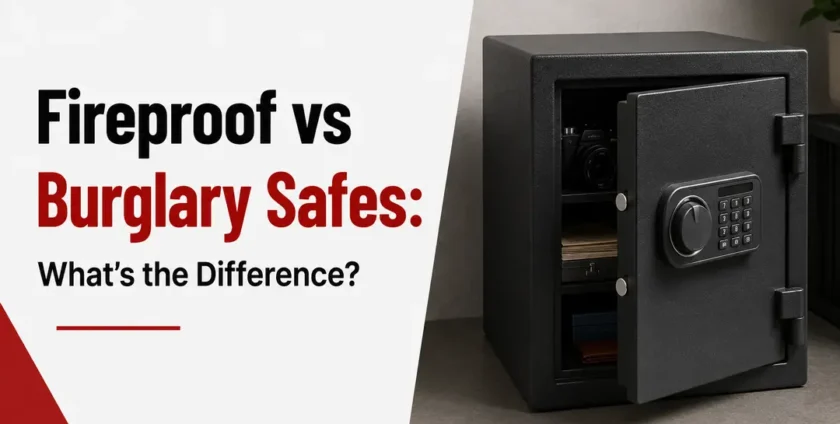
When shopping for a safe, many people assume one safe protects against everything. But that is not always true.
A fireproof safe and a burglary safe are designed for different types of protection. A fireproof safe is mainly built to help protect contents from heat and fire damage. A burglary safe is mainly built to resist forced entry and theft.
Some safes may offer both fire protection and burglary resistance, but the level of protection can vary. That is why it is important to understand the difference before choosing a safe for your home or business.
Hughes Safe & Lock helps homeowners and businesses across South Louisiana choose safes for documents, valuables, firearms, cash, jewelry, business records, and other important items. We serve Denham Springs, Baton Rouge, Covington, Mandeville, Madisonville, Slidell, New Orleans, and nearby communities.
Here is what you should know about fireproof safes vs burglary safes.
What Is a Fireproof Safe?
A fireproof safe is designed to help protect contents from heat during a fire. These safes are commonly used for important papers, records, legal documents, family documents, and other items that could be damaged by extreme heat.
People often use fire-resistant safes for:
- Birth certificates
- Passports
- Property deeds
- Insurance documents
- Wills
- Tax records
- Vehicle titles
- Marriage certificates
- Business records
- Family photos
- Backup documents
A fireproof safe is usually rated for a certain amount of time at a certain temperature. The rating helps explain how long the safe is designed to protect its contents under specific fire conditions.
However, not all fireproof safes are the same. Some are better for paper documents, while others may offer different levels of protection for digital media, valuables, or other items.
What Is a Burglary Safe?
A burglary safe is designed to help protect contents from theft and forced entry. These safes are typically built with stronger materials, heavier construction, better locking systems, and more resistance against tampering.
People often use burglary safes for:
- Jewelry
- Cash
- Watches
- Firearms
- Collectibles
- Business deposits
- Important keys
- Precious metals
- Sensitive business materials
- High-value personal items
A burglary safe focuses more on physical security. It is built to make unauthorized access more difficult.
If theft protection is your main concern, a burglary safe may be a better fit than a basic fire safe.
Fire Protection and Theft Protection Are Not the Same
One of the biggest mistakes people make is assuming that a fireproof safe is automatically a strong burglary safe.
That is not always true.
A safe may be excellent for protecting documents from heat but may not be built to resist serious forced entry. Another safe may be strong against theft but may not offer the fire rating you need for paper records.
That is why you should first decide what you are trying to protect against.
Ask yourself:
- Am I mainly worried about fire damage?
- Am I mainly worried about theft?
- Do I need both fire and theft protection?
- What items will be stored inside?
- How valuable are those items?
- How often will I access the safe?
- Where will the safe be installed?
Your answers will help determine which safe makes the most sense.
When a Fireproof Safe Makes Sense
A fireproof safe may be the right choice if your main goal is to protect paperwork and records from fire damage.
A fireproof safe may be useful for:
- Homeowners storing family documents
- Families protecting passports and certificates
- Small business owners storing records
- Landlords storing property documents
- Professionals storing important paperwork
- Anyone who wants backup protection for irreplaceable documents
If the contents are mainly paper-based, fire protection should be a major consideration.
However, if you are storing high-value jewelry, cash, firearms, or business deposits, you should also think about burglary resistance.
When a Burglary Safe Makes Sense
A burglary safe may be the right choice if your main concern is unauthorized access or theft.
A burglary safe may be useful for:
- Jewelry storage
- Cash storage
- Firearm storage
- Business deposits
- High-value watches
- Collectibles
- Sensitive business items
- Important keys
- Valuables that need stronger theft protection
Burglary safes are often heavier and stronger than basic document safes. They may also have better locks, stronger doors, and better resistance against prying or drilling. If you plan to secure physical property, it helps to know how baseline defenses vary, similar to evaluating high security locks vs standard locks for your doors.
If the contents are valuable enough to attract theft, burglary protection should be a priority.
Can One Safe Protect Against Both Fire and Theft?
Yes, some safes are designed to offer both fire protection and burglary resistance. But not every safe offers both equally.
A safe may have a fire rating and also include stronger construction for theft resistance. However, the level of protection depends on the safe’s design, materials, lock type, weight, and rating.
If you need both fire and theft protection, do not assume any safe will work. Ask a safe professional to help you compare options.
For many homeowners and businesses, a combination safe may be the most practical choice.
What Should You Store in a Fireproof Safe?
A fireproof safe is often best for documents and items that could be damaged by heat.
Common items include:
- Birth certificates
- Passports
- Property records
- Insurance policies
- Tax documents
- Legal papers
- Family records
- Medical records
- Vehicle titles
- Business paperwork
- Printed photos
If you are storing digital media, drives, or electronics, ask whether the safe is appropriate for those items. Some items may require more specific protection than standard paper documents.
What Should You Store in a Burglary Safe?
A burglary safe is often better for items that someone may try to steal.
Common items include:
- Jewelry
- Cash
- Watches
- Firearms
- Coins
- Collectibles
- Precious metals
- Business deposits
- High-value keys
- Sensitive items
If you are storing both documents and valuables, you may need a safe that offers both fire protection and burglary resistance.
Fireproof Safe vs Burglary Safe for Homeowners
For homeowners, the right safe depends on what matters most.
If you mainly want to protect family documents from fire, a fireproof safe may be enough. If you want to protect jewelry, cash, firearms, or valuables, theft resistance becomes more important. Knowing how to choose the right safe for your home involves evaluating these exact priorities.
Many homeowners need both.
For example, a family may want to store passports, birth certificates, jewelry, and cash in the same safe. In that case, a basic fire box may not provide enough theft protection, while a burglary safe without fire protection may not be ideal for documents.
A safe professional can help you choose the right balance.
Fireproof Safe vs Burglary Safe for Businesses
Businesses often have different safety needs than homeowners.
A business may need to protect:
- Cash
- Deposits
- Keys
- Records
- Contracts
- Sensitive files
- Employee documents
- Inventory items
- Access cards
- Financial paperwork
For businesses, burglary protection may be especially important if the safe stores cash, deposits, or high-value items. Fire protection may also matter for documents, records, and paperwork.
The right business safe depends on the type of business, the value of the contents, who needs access, and where the safe will be installed.
Safe Size Matters Too
Whether you choose a fireproof safe, burglary safe, or combination safe, size matters.
Many people buy a safe that fits their current items, but forget about future storage. Over time, you may need space for more documents, valuables, firearms, or business records. Taking the time to calculate what size safe you need for your home or business will save you from outgrowing your security investment down the road.
Before choosing a size, think about:
- What you need to store today
- What you may need to store later
- Whether folders or binders need to fit
- Whether jewelry or valuables need organization
- Whether firearms or accessories need space
- Whether multiple people will use the safe
It is often better to choose a safe with extra room than to outgrow it quickly.
Safe Weight and Installation Matter
A safe’s location and installation can affect its security.
A very light safe may be easier to move, but that can also make it easier for someone else to remove. A heavier safe may offer better protection but may require professional placement.
Some safes can be bolted down to make removal harder. This is especially useful for smaller safes or safes placed in accessible areas.
Professional installation can help with:
- Placement
- Anchoring
- Floor support
- Door clearance
- Safe positioning
- Access convenience
- Security planning
If you are buying a safe for theft protection, installation should be part of the decision.
Lock Type Is Also Important
Safes can come with different lock types.
Common lock options include:
- Mechanical dial locks
- Electronic keypad locks
- Key locks
- Combination locks
- Biometric locks
- Dual-lock systems
The right lock depends on how often you use the safe, who needs access, and how comfortable you are with the lock system.
For example, an electronic keypad may be convenient for frequent access, while a mechanical dial may appeal to someone who wants a lock without batteries.
A locksmith or safe professional can help you understand which lock type fits your needs.
Questions to Ask Before Buying a Safe
Before choosing a safe, ask:
- What am I protecting?
- Am I more concerned about fire, theft, or both?
- How much space do I need?
- Will I need more space later?
- Where will the safe be installed?
- Does the safe need to be bolted down?
- How often will I open it?
- Who needs access?
- What lock type is best?
- Do I need professional installation?
- Can the safe be serviced later if there is a problem?
These questions can help you avoid buying the wrong safe.
Common Mistakes to Avoid
When comparing fireproof safes and burglary safes, avoid these mistakes:
- Assuming every safe is fireproof
- Assuming every safe is burglary-resistant
- Buying based only on price
- Choosing a safe that is too small
- Ignoring safe weight
- Ignoring installation needs
- Buying a safe without understanding the lock type
- Storing high-value items in a basic firebox
- Storing important documents in a safe with no fire protection
- Not asking for professional advice
A safe should match the risk you are trying to reduce. Learning how to choose a licensed locksmith in Louisiana ensures you have access to qualified professionals who can evaluate these risks objectively.
Should You Buy a Safe Online or From a Safe Professional?
Buying a safe online can be convenient, but it may be hard to judge quality, size, weight, protection level, and installation needs from a product listing.
A locksmith or safe professional can help you choose a safe based on what you actually need to protect.
Working with a professional can be especially helpful if:
- You are choosing between fire and theft protection
- You need a safe for valuables
- You need a gun safe
- You need a business safe
- You need help with installation
- You want the safe bolted down
- You may need safe service later
- You are unsure what size to choose
Hughes Safe & Lock can help homeowners and businesses compare safe options and choose the right fit. If you find yourself locked out of your current unit or experiencing a mechanical failure, utilizing an emergency locksmith is often necessary to safely regain access without destroying your property.
For standard projects, calculating how much a locksmith costs in Louisiana beforehand will help keep your maintenance budget clear.
Get Help Choosing the Right Safe
A fireproof safe and a burglary safe serve different purposes. A fireproof safe helps protect against heat and fire damage. A burglary safe helps protect against theft and forced entry.
The right choice depends on what you need to store, where the safe will be installed, and what kind of protection matters most.
If you need both fire and theft protection, ask about safe options that offer a practical balance.
Call Hughes Safe & Lock for Safe Selection and Service
Hughes Safe & Lock helps homeowners and businesses choose, install, open, and service a wide variety of commercial and residential safes across South Louisiana.
We serve Denham Springs, Baton Rouge, Covington, Mandeville, Madisonville, Slidell, New Orleans, and nearby areas.
Whether you need a fireproof safe, burglary safe, gun safe, jewelry safe, document safe, or business safe, our team can help you choose the right option.
For professional safe service or to explore our complete security offerings, please feel free to call Hughes Safe & Lock at 225-664-2815 or 985-809-5625.
FAQs About Fireproof vs Burglary Safes
Is a fireproof safe also burglary-proof?
Not always. A fireproof safe is mainly designed to help protect contents from heat and fire. It may not offer the same theft protection as a burglary safe.
What is a burglary safe?
A burglary safe is designed to resist forced entry and help protect valuables from theft. It is usually stronger and more security-focused than a basic fire safe.
Which safe is best for documents?
A fireproof safe is often best for important paper documents because it is designed to help protect contents from heat.
Which safe is best for jewelry and cash?
A burglary safe is usually better for jewelry, cash, watches, and other high-value items because theft protection is the main concern.
Can one safe protect against both fire and theft?
Yes, some safes offer both fire protection and burglary resistance. The level of protection can vary, so it is important to choose carefully.
Can Hughes Safe & Lock help me choose a safe?
Yes. Hughes Safe & Lock can help homeowners and businesses choose safes for documents, valuables, firearms, cash, jewelry, and business needs across South Louisiana.
- By: andrew
- Category: Home Security
- 0 Comments
 Hughes Safe & Lock provides the finest quality work for residential and commercial clients.